How Emotional Self-Awareness Improves Mental Health
Most of us move through our days on autopilot. When someone asks how we are, we default to “fine” or “just busy”. Beneath that surface, though, is a shifting mix of feelings we rarely pause to identify.
That gap — between what we are experiencing and what we consciously understand — is where stress builds, relationships fray, and snap decisions happen.
Bridging it starts with a single, trainable skill: emotional self-awareness.
1) What is emotional self-awareness?
Emotional self-awareness is not about over-analysing yourself or forcing yourself to feel happier. It is the simple, non-judgemental ability to recognise what you are feeling in the moment and (as best you can) understand what is driving it.
It tends to involve:
Tuning into the body: noticing cues like a tight chest, a warm face, heavy limbs, or shallow breathing.
More precise naming: moving beyond “bad” or “stressed” to the closest-fit word (for example, resentful, anxious, dismissed).
Tracking triggers: recognising the situations, times of day, or interactions that reliably shift your mood.
Observing without fixing: letting an emotion exist for a moment without immediately suppressing it, escaping it, or explaining it away.
2) The science: why naming can calm the amygdala
Your brain relies on a balance between two systems:
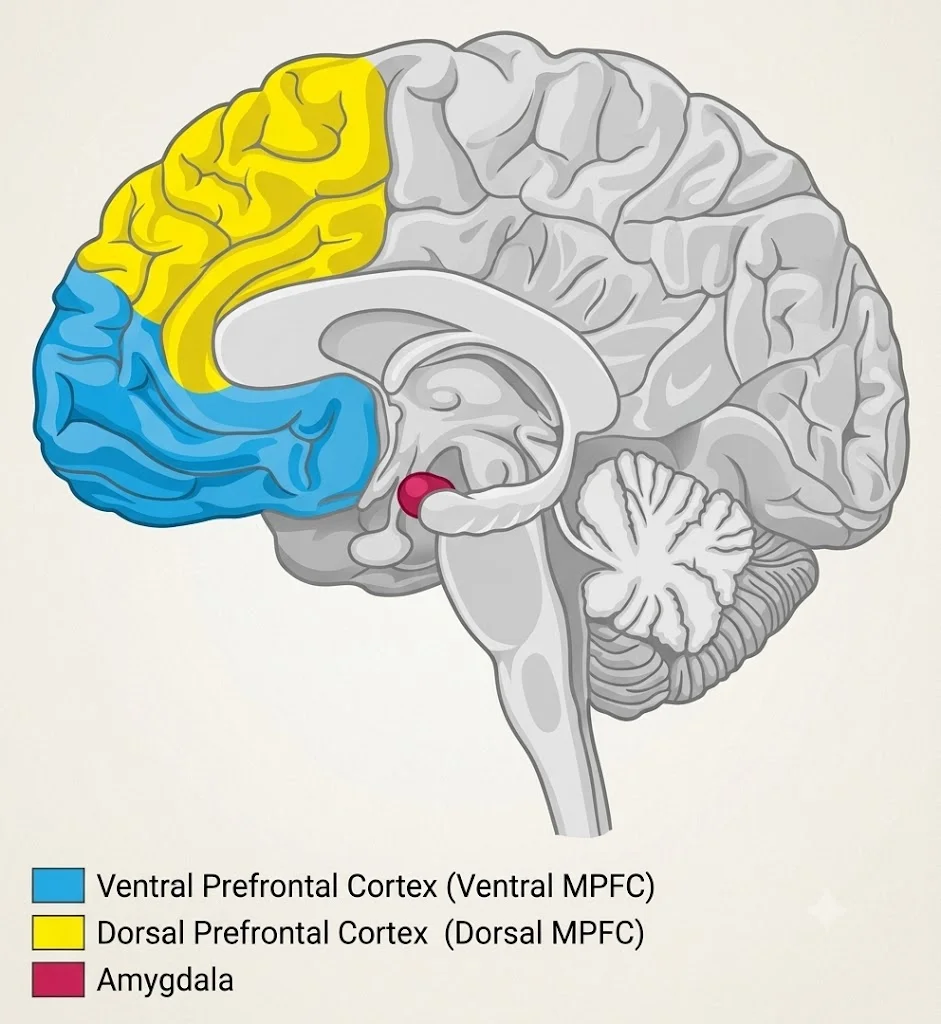
The ventral and dorsal prefrontal cortex (“thinking brain”) and the amygdala (the brain’s alarm system).
The amygdala: your rapid-response alarm system. It scans for threat and can flood the body with stress hormones in milliseconds.
The prefrontal cortex (PFC): your “thinking brain”. It supports reflection, planning, and self-control.
When you are triggered without awareness, the amygdala tends to take the wheel (sometimes described as an “amygdala hijack”). You might snap at a partner, fire off an angry message, or shut down.
But when you pause to label what you are feeling, the dynamics can shift.
In a landmark fMRI study, participants who simply named the emotion they saw in a distressing image (known as affect labelling) showed reduced amygdala activity alongside increased activity in prefrontal regions linked to regulation (Lieberman et al., 2007).
Putting a feeling into words acts like a biological brake. It does not erase the emotion — it reduces its intensity enough to give you choice: What do I want to do next?
Lieberman et al., 2007
3) Why it matters for mental health
Stress becomes more manageable
“Stress” is a big, blurry label. When everything is just “stress”, you can feel helpless. When you get more specific, the problem becomes clearer and more solvable.
For example: “I’m not just stressed — I’m feeling inadequate after that meeting, and I’m also physically exhausted.”
This kind of precision is often called emotional granularity, and it is linked to healthier coping and emotion regulation (Kashdan et al., 2015).
Relationships improve
Without self-awareness, it is easy to project discomfort onto the people around you. You might mistake exhaustion for irritation at someone else.
When you know what is happening internally, you can communicate and set boundaries without blame:
“I’m irritable because that meeting was tense — not because of what you did. I need ten minutes to decompress.”
Higher emotional abilities have been associated with better social functioning and relationship outcomes (Brackett et al., 2006).
Decisions get clearer
Emotions are useful data — but only when you can read them. Without awareness, decisions can be driven by temporary states: quitting in a burst of anger, or staying stuck out of unnamed fear.
Self-awareness gives you a pause to ask:
Is this feeling pointing to something important, or is it a short-term reaction to being tired, hungry, or overwhelmed?
4) How to build the skill (four daily habits)
Like any skill, emotional self-awareness improves with practice. Try these simple habits:
1. Expand your emotional vocabulary
The richer your vocabulary, the easier it is to identify what is actually going on. Next time you feel “bad”, go three layers deeper.
Angry — or unappreciated?
Sad — or disappointed?
Anxious — or uncertain?
An emotion wheel can help when you are stuck.
2. Locate the feeling in your body
Your body often notices emotion before your mind does. When you feel a shift, take a quick inventory: jaw, shoulders, breath, stomach, chest. These are early-warning signals — and they are learnable.
3. Track patterns (lightly)
You do not need to analyse every moment. Just notice trends.
Do you consistently feel anxious at a particular time of day?
Do certain conversations leave you drained?
Patterns make triggers predictable — and predictability makes coping easier.
4. Practise “clean” observation
Many of us judge emotions: “I shouldn’t feel this.” That piles shame on top of the original feeling.
Try a neutral, almost scientific stance:
“I’m noticing jealousy.”
“I’m noticing a wave of guilt.”
Let it be there for a moment before you act.
5) Get started: the 60-second check-in
You do not need a long meditation practice to build emotional self-awareness. You just need a pause.
Right now, take one slow breath. Scan your body and mind, and ask:
What is the primary emotion I’m carrying in this moment?
Name it. Breathe. That tiny pause is where resilience begins.
Track your emotions visually
Building a consistent check-in habit is easier when you can see your progress. Emochi turns daily check-ins into a personalised visual calendar so you can spot patterns, track change, and understand your mind at a glance.
Brackett, M. A., Rivers, S. E., Shiffman, S., Lerner, N., & Salovey, P. (2006). Relating emotional abilities to social functioning: A comparison of self-report and performance measures of emotional intelligence. Journal of Personality and Social Psychology, 91(4), 780–795. https://doi.org/10.1037/0022-3514.91.4.780
Kashdan, T. B., Barrett, L. F., & McKnight, P. E. (2015). Unpacking emotion differentiation: Transforming unpleasant experience by perceiving distinctions in negativity. Current Directions in Psychological Science, 24(1), 10–16. https://doi.org/10.1177/0963721414550708
Lieberman, M. D., Eisenberger, N. I., Crockett, M. J., Tom, S. M., Pfeifer, J. H., & Way, B. M. (2007). Putting feelings into words: Affect labeling disrupts amygdala activity in response to affective stimuli. Psychological Science, 18(5), 421–428. https://doi.org/10.1111/j.1467-9280.2007.01916.x
Emochi is not a clinical tool and does not provide therapy, diagnosis, or medical advice. It is informed by published research in affective neuroscience and emotion regulation.